Built by Alexis Irénée du Pont (d. 1857, photographs), third son of Éleuthère Irénée du Pont (d. 1834), French immigrant to America, gunpowder manufacturer, and founder of DuPont Chemical. You may read more about Alexis I. du Pont, his building of the church, his death, and the fate of this building here.
Wilmington, Delaware was the site of the first Swedish settlement in the New World, Fort Christina. The first Swedes arrived in 1638, but by 1655, the Fort was surrendered to the Dutch and then came under English rule in 1664.
The Old Swedes Historic Site includes the church built by the Swedish settlers at the end of the 17th century. You may read more about the church here and watch a tour of the church here.
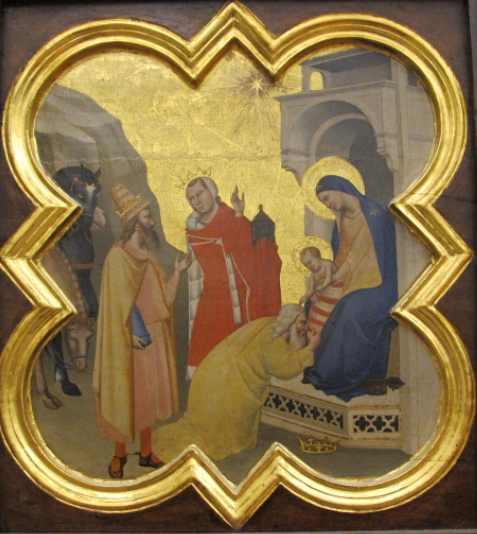
The three works of art selected for highlighting and illustration are, sadly, not actually by Giotto (d. 1337).
The first, The Shepherd Sitting Under His Tent, is today in in the Museo dell’Opera del Duomo, while a copy adorns the exterior of the Campanile. More precisely titled, Jabal: L’invenzione della pastorizia (Jabel: The Invention of Sheep Herding) – “And Ada brought forth Jabel: who was the father of such as dwell in tents, and of herdsmen.” Genesis 4.20 – may have been conceived by Giotto, but was carved by Andrea Pisano (d. 1348), who succeeded Giotto as Master of the Works of the Duomo in Florence and whose work certainly shows Giotto’s influence.
The second, the Visit of the Magi, today in the Galleria dell’Accademia, was painted by Taddeo Gaddi (d. 1366), his most talented pupil.
The third, the Meeting of Anna and Joachim, a fresco in the Capella di Sant’Anna in Santa Maria Novella in Florence, was painted by Nardo di Cione (d. ca. 1366).