30 August – Saint Fiacre

Modern Hagiography

Bibliotheca Sanctorum

Martyrologium Romanum

Roman Martyrology

Sanctorale Catholicum

Lives of the Saints by Alban Butler.

Lives of the Saints by Sabine Baring-Gould.

Pictorial Lives of the Saints 

Pictorial Half Hours with the Saints by Auguste François Lecanu.

Little Patron of Gardners: Good Saint Fiacre by Catherine Beebe.

Lives of the Irish Saints by John O’Hanlon.

Tradition in Action

Vie et miracles de Saint Fiacre – Librivox Recording 

18C Vie 

Medieval Hagiography

BHL, Supplement 

Acta Sanctorum, translation

The Golden Legend 

Art & Architecture

Index of Medieval Art

Portail Biblissima

POP : la plateforme ouverte du patrimoine

Europeana

A Guide to Christian Iconography: Images, Symbols, and Texts 

Medieval Religion Listserv – 2016 Dillon.

15C Sculpture 

16C Stained Glass 

Post-Biblical Saints Art Index
Saints and their Attributes
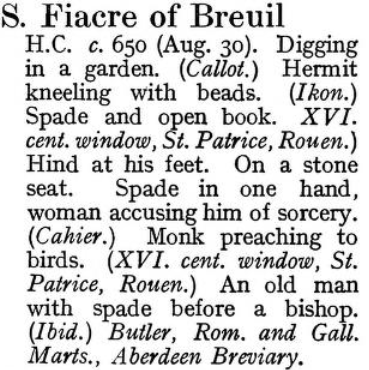
Saints and their Emblems

Caractéristiques des saints dans l’art populaire by Charles Cahier – bêche, ermite, femme, vases domestiques.

Lives and Legends of the English Bishops and Kings, Mediaeval Monks, and Other Later Saints by Mrs. Arthur Bell.

The Saints in Art by Joseph Maria von Radowitz.

Emblems of Saints by Which They Are Distinguished in Works of Art by F. C. Husenbeth.

Customs & Devotions

Late Medieval French Devotion

30 August – Saint Felix & Saint Adauctus

Catacomba di Commodilla, Roma
Annus Dierum Sanctorum
Confringam illos, nec poterunt stare, cadent subtus pedes meos.
I will break them, and they shall not be able to stand: they shall fall under my feet.
Psalm 17.19

Modern Hagiography

Bibliotheca Sanctorum

Martyrologium Romanum

Roman Martyrology

Lives of the Saints by Alban Butler.

Lives of the Saints by Sabine Baring-Gould.

The Lives of Saints, with Other Feasts of the Year, According to the Roman Calendar by Peter Ribadeneira.

La vie des saints

Medieval Hagiography

BHL, Supplement 

Acta Sanctorum, translation

The Cult of Saints in Late Antiquity Database

Epitaph of Damasus 

The Golden Legend (and illustrations)

Art & Architecture

Index of Medieval Art – Felix & Adauctus

Catalogo generale dei beni culturali

BeWeB

Portail Biblissima

POP : la plateforme ouverte du patrimoine

Warburg Institute Iconographic Database

Shrine of Saints Felix ad Adauctus in the Catacomb of Commodilla

15C Painting with Saint Barbara  

Saints and their Emblems

Caractéristiques des saints dans l’art populaire by Charles Cahier – idole.

Music

Cantus: A Database for Latin Ecclesiastical Chant

A Carolingian Pastoral Handbook for Monks, Einsiedeln MSS 281 & 199, page 4

Page 4

Regula Benedicti, chapter 4.73

Intratext / Archive.org / The Latin Library

English Translation (with sources)

(1) spiritalis que cum fuerint a nobis die / quae

spiritual which when they are by us day

(2) noctuque incessabiliter adimpleta

and night unceasingly fulfilled

(3) et in die iudicii consignata illa mer / reconsignata

and on the day of judgment consigned these things with the mer-

(4) cis nobis a d[omi]no reconpensabitur qua[m] / merces, recompensabitur

cy for us from the lord will be rewarded which

(5) ipse promisit quod oculus non vidit

he promised. What the eye did not see

(6) nec aures audivit nec in cor hominis / auris, –

nor ears heard nor into the heart of man

(7) ascendit que preparavit d[eu]s [-] diligen / – , quae, praeparavit, his qui, diligunt

ascended which God prepared for those who love

(8) tibus se ., Officina vero ubi haec omnia / illum

him. The office truly where all these things

(9) diligenter operemur claustra s[un]t

diligently are done are the cloisters

(10) monasterii & stabilitas in congregatione .,

of the monastery and the stability in the community.

********************************************************************

Sermon 60 of Caesarius of Arles/Sermon 256 of Pseudo-Augustine

Translation / Latin / Latin with French Translation

(11) INCIP[IT] ADMONITIO DOM

Here begins an admonition of Lord

(12) NI CAESARII PER QUA[M] OSTEN

Caesarius through which it is

(13) ditur quid intersit inter illa pe / illam

shown what is different among those pen-

(14) nitentia que cum bonis operibus / penitentiam, quae

ances which with good works

(15) semper agitur & illam quae in in

always are done and that which in in-

(16) firmitate vel finem vite accipit / vitae, accipitur

firmity or the end of life is accepted.

(17) Multi de fratribus

Many from our brothers

(18) vel filiis nostris solliciti s[un]t

or sons worried are

(19) verum om[nis] homo in infirmi / utrum

whether every man in sickness

(20) tatem [] si penitentia[m] ac / infirmitate, positus

if penitent and also

(21) cepit & statim defunctus fuerit / accipit

receives and immediately dies

(22) ad plenam possit indulgentiam per

full remission is able to reach.