
Modern Mariology
“The Virgin of Albert” by George Herbert Clarke.
Art & Architecture
Modern Mariology
“The Virgin of Albert” by George Herbert Clarke.
Art & Architecture
Sermon 60 of Caesarius of Arles/Sermon 256 of Pseudo-Augustine
Translation / Latin / Latin with French Translation
(1) venire et dum haec inquirunt non
obtain and when about these things they inquire, not
(2) sine parva inter se animositate
without small animosity, among themselves
(3) contendunt ., Alii enim dicunt eu[m]
they dispute. For some say that he
(4) qui sic acciperit ad integru[m] liberari / acceperit
who thus accepts is free to the entirety,
(5) alii enim parvum prodesse confir / parum
and others that he reaps small benefit they ass-
(6) mant ., Quid tamen de hac re
sert. What therefore concerning these things
(7) nobis secundum sanctorum patrum regulas
to us according to rules of the holy fathers
(8) videatur breviter caritati vestrae
may be seen briefly in your charity
(9) volo suggerere non incongruae po / incongrue
I want to suggest not incongruously that it is poss-
(10) test credi tribus modis adistam su
ible to believe in three ways that sud-
(11) bitaneam paenitentiam perve
den penitence be achiev-
(12) nire ., Primus & precipuus modus / perveniri, praecipuus
ed. The first and foremost way
(13) est ut XPIam capitalia crimi / XPIanus, crimina capitalia
is for a Christian a capital sin
(14) na non admittat ut si forte ad / aut
not to commit so that if by chance
(15) misit sic pro illis peniteat & ea / miserit, paeniteat
he commits thus for them he may do penance and these sins
(16) bonis operibus deleat ut postea / diluat
with good works may erase so that afterward
(17) ad peccata ipsa non redeat ., De / reddat
to these sins he may not return. From
(18) omnibus fructibus decimas reddat
all fruits one tenth he should give back
(19) et de nove partibus quicquid suis / novem
and from the nine parts whatever for his
(20) necessitatibus superfuerit
needs may exceed
(21) minuta peccata que cottidie sub / quae cotidie
for the small sins that he daily
(22) ripunt redimat Et illa carita / ripiunt illam
steals he may redeem and this charity
(23) tem teneat que non solum ami / quae
he may hold that non only
(24) cos s& & ipsos diligat inimicus / diligit inimicos
friends but also even those enemies he may love.


Modern Hagiography
Martyrologium Romanum – 15 August & 16 August
Lives of the Saints by Alban Butler.
Lives of the Saints by Francis Weninger.
Lives of the Saints by Sabine Baring-Gould.
The Liturgical Year by Dom Guéranger.
Our Birthday Bouquet Culled from the Shrines of the Saints and the Gardens of the Poets by Eleanor C. Donnelly.
Pictorial Half Hours with the Saints by Auguste François Lecanu.
Miniature Lives Of The Saints For Every Day In The Year by Henry Sebastian Bowden.
Stories of the Saints Fifth Series by Mary Seymour.
Memorials of the Blessed: A Series of Short Lives of the Saints by Charles B. Fairbanks.
The Lives of Saints, with Other Feasts of the Year, According to the Roman Calendar by Peter Ribadeneira.
Medieval Hagiography
Breviarium Romanum – Latin & English.
Writings of Saint Stephen
Admonitions from Saint Stephen to His Son– excerpt, excerpts
Art & Architecture
Portrait on Coronation Pall, see also, Wikimedia Commons
Saint Stephen’s Basilica and the Hand of Saint Stephen
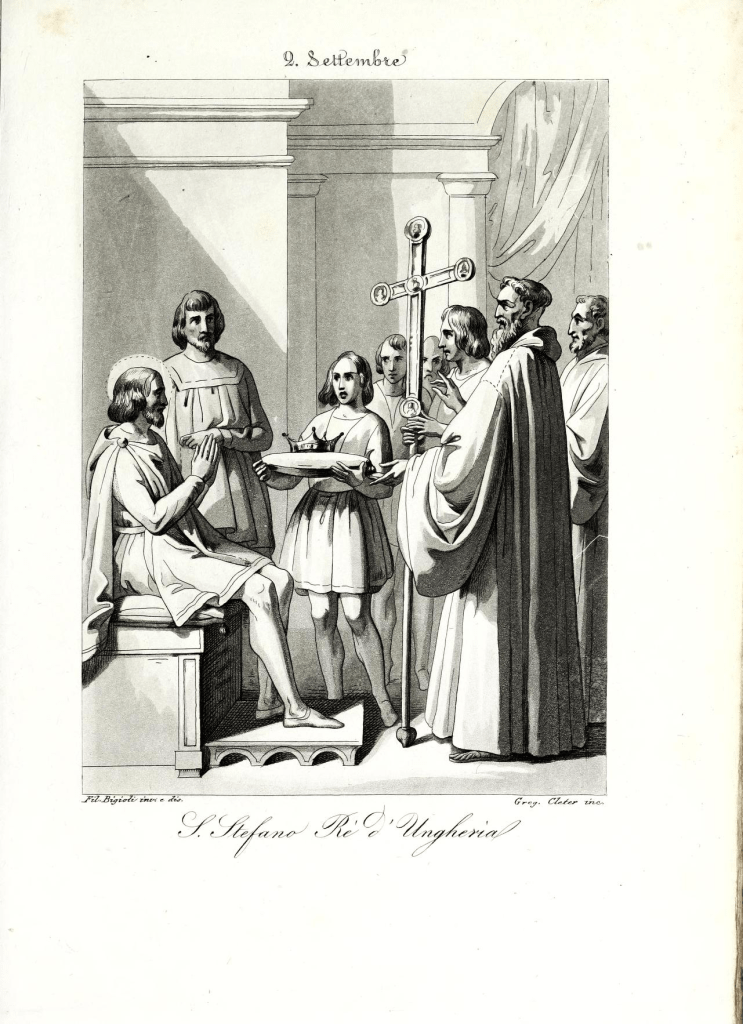
Chronicon Pictum – Saint Stephen’s Birth, Portrait, Stephen Intercept Gyula, Stephen Executes Koppany, Stephen Defeats Kean, Funeral of Son, Manuscript in its entirety
Baptism of Saint Stephen, also

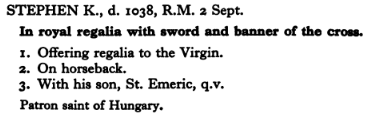
Legends of the Monastic Orders as Represented in the Fine Arts by Mrs. Jameson.
A Handbook of Christian Symbols and Stories of the Saints as Illustrated in Art by Clara Erskine Clement.
Lives and Legends of the English Bishops and Kings, Mediaeval Monks, and Other Later Saints by Mrs. Arthur Bell.
Saints and their Symbols: A Companion in the Churches and Picture Galleries of Europe by E. A. Greene.
The Saints in Art by Joseph Maria von Radowitz.
Music
Cantus: A Database for Latin Ecclesiastical Chant
Beethoven, King Stephen (background)
Ferenc Erkel, István király (King Stephen)
Zoltán Kodály, Ének Szent István királyhoz (Hymn to King Stephen)
István, a király (Stephen, the King) (a Rock Opera)
Customs & Devotions

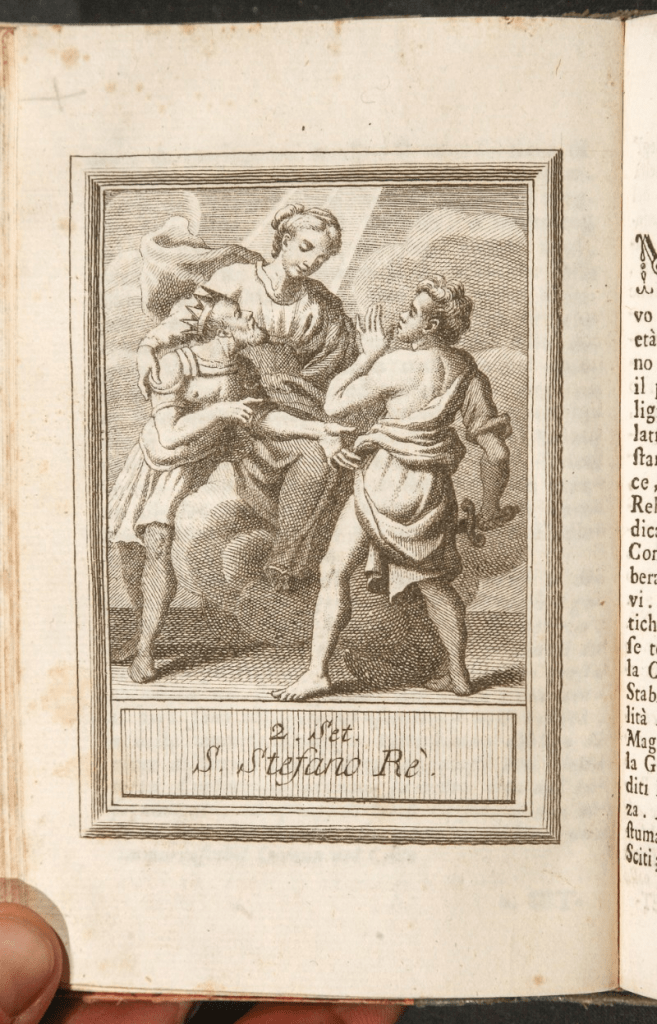

 Nihil sub sole novum