
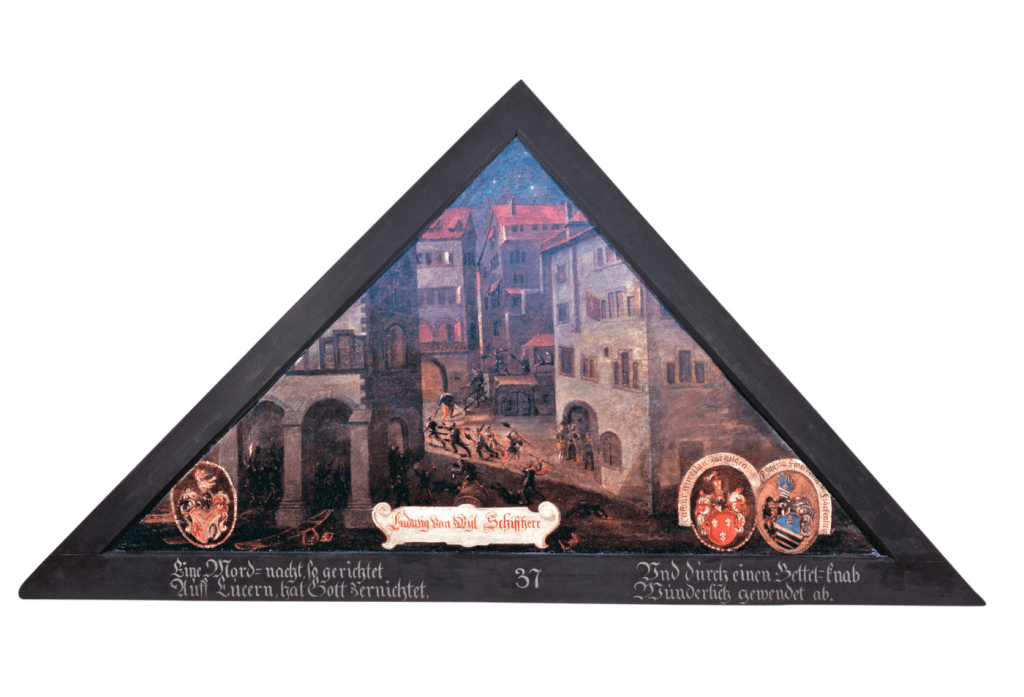
Die Verschwörer der Luzerner Mordnacht werden unter dem Zunfthaus zu Schneidern von einem Knaben überrascht (1343)
The Conspirators of the Lucerne Murder Night are Surprised by a Boy under the Schneidern Guild House (1343)
Meinrad Lienert, Schweizer Sagen und Heldengeschichten (1915).
Soon after the Battle of Morgarten, in which the three states of Uri, Schwyz and Unterwalden had forever freed themselves from the Austrian yoke of the evil governors, the city of St. Leodegar, Lucerne, located down by the mountain lake, also joined their alliance, so that one Now these four allied countries around the lake are called the Waldstätte to this day and after them the beautiful, many-armed lake is called Lake Lucerne.
But the Duke of Austria, who owned the city of Lucerne, did not agree with this alliance at all. He therefore tried in every way to bring the renegade, freedom-loving city back under his control. But the citizens of the city were on their guard and did not allow themselves to be taken by surprise by the bailiffs and Austrian nobles who ruled outside the city walls.
Now there was a large group of noble people living in the city who would have liked to remain Austrians, as they liked playing the proud cock next to the Austrian peacock rather than maintaining false friendship with the cattle-herding farmers of the three countries. They therefore conspired, even with a letter and seal, to attack all important Confederate supporters in one night and murder them in their beds. Then they wanted to open the gates to the Austrian nobles and their people waiting outside and hand the city back to them. The traitors kept the matter secret so that no one in the city except them found out about the evil plot. As a symbol of identification among themselves, they all wore a red sleeve. It was on Jacobite Day in the year of salvation 1333 on a dark but starry night. Above Mount Pilatus, whose faint outlines looked threateningly into the towered city, the half moon still stood and illuminated the play of the waves that a mild easterly wind, in which the scent of mountain pastures wafted, drove to the city’s open lake area.
Everything seemed to have calmed down long ago. There was complete silence everywhere, only the water swirled around the fishing boats on the lake.
A poor boy in a tattered doublet and panties slowly walked into the city from the lake. But no one heard him walking because he walked barefoot, and only his faint shadow appeared now and then on the steep walls of the houses. He had done a little fishing at the lake, perhaps to win his poor mother some dinner. He was gradually lulled to sleep by the monotonous lullaby of the playing waves. In his hand he carried a jug with a few fish swimming in it, and in one arm he held the fishing rod.
He got deeper and deeper into the dead quiet city, which seemed to be deserted. And although the narrow streets stared at him like open coffins, he wasn’t afraid and just wanted to get home soon, reaching out more quickly.
But as he approached the large corridors under the candle arches at von Wyl’s house, he suddenly stopped in surprise. There was a strange clinking and murmuring at the candle arches under the tailors’ guild house and drinking room.
For a moment he thought about escaping as quickly as possible, because the poor souls were probably having their nightly intercourse under the arch. But he trusted in God, made a cross and quietly crept towards the candle arch.
Then he saw in the corridors, in the faint light of the setting moon, a large group of men, all heavily armed, and recognized them, especially by their red sleeves, as the most distinguished families of the city. And when he got very close to them, he noticed from their speeches that they planned to attack the city’s federally-minded citizens after midnight, to murder them mercilessly and to open the city gates to the enemies waiting outside.
Terror-stricken, he wanted to sneak away. But some of the conspirators saw his shadow scurrying along the houses. They pursued him, and when they caught up with him, they brought him back under the candle arches. They first wanted to stab him there. But when the conspirators saw the trembling, half-naked boy with his mug shrinking like a heap of misery before their spears, they took pity on him. But he had to swear not to tell anyone what he had heard under the candle arch. Nor did they let him go, but kept him in their ranks.
But when the moon had completely set and only the stars looked over the city walls, their speeches became more eager again. They prepared for an attack and forgot the boy. So he managed to sneak away unnoticed by them. Still pale with horror at what he had heard, instead of going home, he hurried around the city to see if there wasn’t a light still burning somewhere in a guild hall where people always drank in the deep night.
He was delighted to see the illuminated windows in the butcher’s guild room. He made his way up the steep spiral staircase into the butcher’s spacious drinking room. There he crept behind the large tiled stove. But the citizens, who were doing their merry cup-tossing and throwing, paid no attention to him.
Then he suddenly started talking loudly and shouted: “O oven, oven!” Now a few men glanced around at him briefly, but then they continued playing. After a while he raised his voice even louder and shouted: “O oven, oven, if I could speak!” Now the guild members took notice and snapped at him in a surly and astonished manner: “What kind of foolish fun are you doing behind the stove so late? What has the stove done to you? Are you crazy? Or what’s wrong with you?” But the boy now answered, somewhat intimidated: “Oh, nothing.” But after a while it became difficult for him, because the hour would soon come when the murder would begin. And although he had sworn not to tell anyone about the nefarious attack, he now took courage and shouted for the third time: “O Ofen, Ofen, I have to complain to you, because I’m not allowed to tell anyone. There are many People gathered under the large candle arch near the Egg. They want to commit murder in this city this night. O oven, oven, that is the holy truth!”
Now the carousing guildsmen noticed the disaster. They started up in fright, and without asking the boy anything further, they quickly left the drinking room and, to arm themselves, ran quietly home and then to the mayor and all the confederate-minded people in the city. Above all, they occupied the city gates.
Soon they were together in a huddle, and when the Rolandshorns of Lucerne began to terribly horn everything out of the beds, the conspirators under the candle arch knew that their betrayal had come to an end. So they hurriedly ran to their mansions. But a few more of them were caught and now, since they all wore red sleeves, they recognized the entire conspiracy, which was soon drafted. The traitors would probably have lost their lives if God had not had mercy on them, just as they had mercy on the little boy who ran into their hands and saved them from a monstrous crime. At the intercession of the Confederates of the three countries who rushed to help, they gave life to the conspirators, and they later became loyal and loyal Confederates.
But we don’t even know the name of the poor little boy who saved the city with his good head and brave heart. So let us read it together in the book of eternal life.
Translation courtesy of Google Translate.

 Nihil sub sole novum